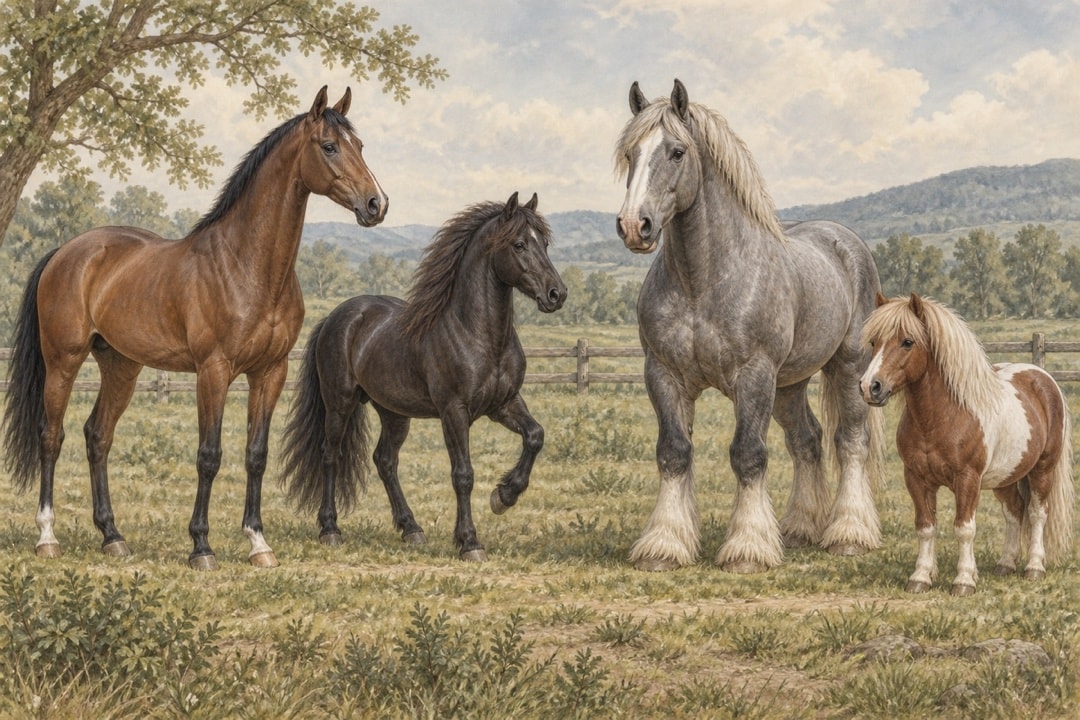
What a breed name tells you
A breed registry keeps the record of horses that meet its rules for entry. A pedigree names the ancestors. A working type groups horses by a shared trait, such as the strength to pull a heavy load. Horses from different studbooks can do the same job.
Listen to a Missouri Fox Trotter and you can hear the gait that gave the breed its name. For a zorse or a zonkey, the names tell you which animals were crossed. For a Spanish Arabian, the studbook records tell you where a particular line began.
Horses with an extra gait
Missouri Fox Trotter
In the Missouri Ozarks, a horse had to carry a rider over uneven country for hours. At the rail, pick a front foot and the opposite hind foot. At an ordinary trot they touch down together. At the fox trot, the forefoot lands a fraction ahead of its partner. There is always a foot on the ground.
Now watch the same horse at a flat foot walk. Each foot comes down in turn at even intervals. The hind hoof reaches beyond the print the front hoof left on that side. Both gaits have four footfalls, but only the fox trot breaks up the diagonal pairs. The breed association’s account of the gaits
In the show ring you may see the flat foot walk followed by the fox trot. A three-gait performance class adds the canter. An in-hand model class asks the judge to look at conformation, the way the horse is built, and also to see it walk. How the classes are judged
- Tennessee Walking Horse
- Its running walk has four beats, and the hind feet reach past the tracks of the forefeet. Watch the nod of the head in time with the stride.
- Paso Fino
- The four-beat footfalls follow a lateral sequence, one foot at a time. The horse can take very short steps with little forward travel or cover ground with a longer stride.
- Icelandic horse
- Alongside walk, trot and canter, the Icelandic is known for the four-beat tölt. Some also perform the flying pace, a fast lateral gait.
Compare the movement descriptions in the University of Kentucky breed collection, then try the hoofbeat score.
Stock, saddle and sport horses
- Arabian
- A light riding horse with roots in the Middle East. An arched neck and high tail carriage are familiar features. Endurance riding gives its willingness to travel a particular use.
- American Quarter Horse
- Early short-distance racing gave the breed its name. In cattle work, a horse needs to stop, turn and follow the movement of another animal. Those demands help explain its place in the Western arena.
- Thoroughbred
- A breed developed for racing in England. Many Thoroughbreds go on to jumping, eventing or other riding careers. A history on the track is one part of an individual horse’s education.
- Appaloosa
- Closely associated with the Nez Perce and the American Northwest. Some show a striking spotted blanket. The amount and distribution of white vary considerably.
- Morgan
- This American breed traces to a foundation stallion known as Figure. Its compact build suited work in harness and under saddle. A Morgan at a driving show and one on a trail share that history.
- Andalusian
- The name belongs to the Iberian horse tradition. Spanish and Portuguese studbooks distinguish the Pura Raza Española and the Lusitano. A pedigree will tell you which record a particular horse belongs to.
- Warmbloods
- Several sport-horse registries use regional names. A Hanoverian and a Trakehner can both be called warmbloods. The broader term describes a group, while the studbook gives the individual’s recorded breeding.
Oregon State’s 4-H horse project · Iberian studbook history (PDF)
Harness horses and ponies
- Shire
- An English heavy draft breed. Look for a large frame, strength through the shoulder and feathering around the lower legs. Farm and haulage work help explain the scale of the horse.
- Friesian
- The horse of Friesland in the Netherlands has worked on farms and pulled carriages. Its long mane and feathered legs are conspicuous. Harness work is a more revealing clue to its history than color alone.
- Haflinger
- A compact Alpine horse, usually chestnut with a light mane and tail. Its history includes carrying packs and working in harness. Haflingers also appear under saddle.
- Shetland pony
- A small, sturdy pony from the Shetland Islands, with a thick coat. Pony breeds have their own histories and registries. An adult pony is a mature animal.
Kentucky’s draft and pony entries · Friesian Horse Society history
Wild horses and hybrids
Przewalski’s horse is a wild equid with a short upright mane, a stocky body and a dun coat. Conservation breeding made its return to the Mongolian steppe possible after it disappeared from the wild. Our featured equine column follows that story.
Zorse and zonkey
A zorse has a zebra parent and a horse parent. A zonkey has a zebra parent and a donkey parent. Both names tell you the parent species. A registration record can identify the horse parent’s registered breed. Zorse · Zonkey
A mule has a donkey sire and a horse dam. A hinny has a horse sire and a donkey dam. The direction of the cross is in the name, even when the two look very much alike. University of Missouri Extension on mules and hinnies