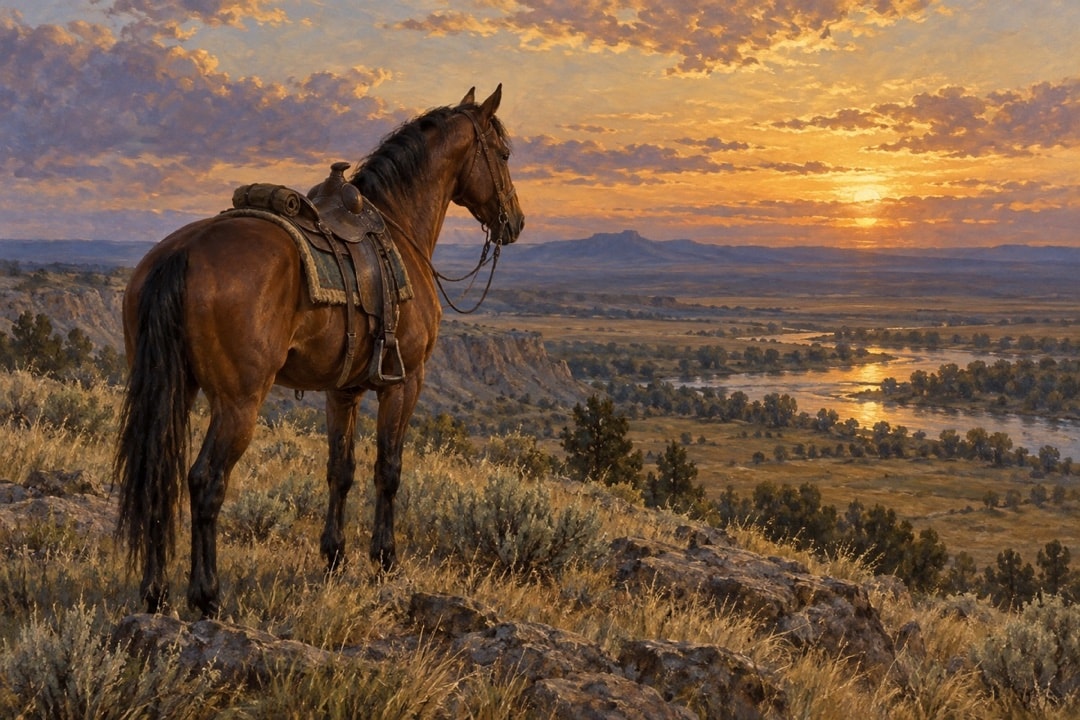
More than a century of cherished sentiment may say otherwise, but the horse of uncertain breeding known as Comanche was not the only survivor of Custer’s Last Stand. Other horses and people survived the larger battle, yet so many were blotted out by the memory of the Seventh Cavalry’s most celebrated horse that they became little more than lines or footnotes.
Why Comanche dominated chapter titles while the others faded is no great mystery. His popularity partly reflected the American appetite for stories of survival. It also demonstrated the military’s ability to create and sustain a useful symbol. Although he was never ridden into battle again after the Little Bighorn, Comanche remained connected to military ceremony, and much of what was repeated about him served that role.
There are a few things about Comanche that can be stated with confidence. He was a bay gelding; his preserved body remains in the care of the University of Kansas. He was owned and ridden by Captain Myles Keogh, not by George Armstrong Custer, though he has often been represented otherwise. Beyond those points, details of his life, his experience at the Little Bighorn and his place in public memory have long attracted disagreement.
Keogh’s cavalry mount
Myles Keogh acquired Comanche from the U.S. Army in 1868. A veteran of the Civil War, Keogh needed a capable mount for cavalry service on the Plains. According to the familiar naming story, the horse received his name after he was wounded during a fight with Comanche people yet continued working so steadily that Keogh did not immediately realize he had been hurt. Like many details in the horse’s biography, the story comes to us through repetition as much as documentation.
Comanche earned his lasting fame in one of the most contested military engagements in American history: the Battle of the Little Bighorn, also known as the Battle of the Greasy Grass. On June 25, 1876, Custer’s portion of the Seventh Cavalry attacked a much larger encampment of Lakota, Northern Cheyenne and Arapaho people. Custer and the soldiers with his immediate command were killed. The battle was a Native victory within a wider war driven by United States expansion into Native lands.
Comanche was found badly wounded when U.S. forces returned to the field. The phrase “only survivor” quickly gathered around him, but it was never literally true. Native warriors and families survived. Other Seventh Cavalry soldiers survived fighting elsewhere on the field. Some cavalry horses were taken away; others were killed or too badly injured to save. Comanche was the living horse recovered by the Army from Custer’s immediate battlefield, a narrower and more accurate distinction.
A rescue told many ways
Argument over the details began almost immediately. Several people were credited with finding Comanche. In some accounts he stood near Keogh’s body; in others he could barely stand. Reports differed over whether arrows or bullets caused his wounds and over how many wounds there were. Each version pushed the horse slightly further from an individual animal and closer to a character in a national story.
Comanche was taken into care and eventually recovered. His status had already changed. Cavalrymen no longer viewed him as an ordinary mount but as a comrade and a memorial. Less than two years after the battle, Colonel Samuel D. Sturgis issued General Orders No. 7, directing that no one ride the horse again. Comanche was given freedom around the post and an honored place in the regiment with which he had served.
Well cared for in his later years, he appeared in military parades and ceremonies. He could be presented saddled and draped in mourning colors, with cavalry boots reversed in the stirrups to signify a fallen rider. Crowds received him enthusiastically. The horse had become a moving monument.
What the symbol concealed
Comanche’s reputation has never been politically neutral. At times, the lone-survivor story supported a heroic account of the Seventh Cavalry while pushing Native victory and Native survival to the edges. The broader setting was the seizure of Native land and a military campaign against people resisting confinement. Remembering the horse without that context turns a complicated history into sentiment.
At the same time, an animal can carry meanings that no institution fully controls. Comanche has also been read as an unbiased witness to the suffering of war, a reminder of colonial violence, and a memorial to the dependence of cavalry soldiers on horses. Those interpretations coexist uneasily, which helps explain why his story continues to be retold.
He remained important to the public until his death in 1891. The regiment decided that his body should be preserved and sent him to the University of Kansas, where naturalist and taxidermist Lewis Lindsay Dyche prepared the mount. An arrangement over Dyche’s work allowed the university to keep Comanche. The horse was displayed at the 1893 World’s Columbian Exposition and later became a prominent object at the university’s natural history museum.
The horse in the museum
Comanche’s physical remains made the legend unusually durable. Books, art, music and museum displays carried his image forward. He also became a focus for debate over ownership, display and interpretation. A preserved animal is not only an object; in this case, it stands at the meeting point of military memory, Native history, museum practice and the human desire to make one survivor speak for an entire event.
The University of Kansas Natural History Museum now presents Comanche as a symbol of conflict between the United States and Native nations of the Great Plains. That framing makes the larger history visible rather than allowing the cavalry legend to stand alone.
Comanche still fascinates because the corrections do not weaken his story. They make it more revealing. He was Keogh’s horse, not Custer’s. He was one survivor among many, not the only living being to emerge from the battle. He was a wounded cavalry gelding who became a ceremonial figure and then a museum object. Around that real animal, a country built a legend—and later generations have continued to ask what the legend leaves out.
Canter Magazine was EquinePost’s affiliated literary quarterly about horses in art, history, travel and culture. Read more about its editorial idea on the Canter Magazine page.