The EquinePost article library was organized around named standing columns rather than a single narrow discipline. Some addressed everyday management; others made room for opinion, business, law, travel and the spectacle of competition. Together they reflected the conversations that happen wherever horse people gather: practical one moment, historical the next, and never far from a strong point of view.
The standing columns
- A Horse, of Course — the broad life of horses and horse people
- Arabian Horse History — origins, influence and bloodline traditions
- Boarding Horses — questions shared by owners and stable managers
- Classical Dressage — balance, gymnastic development and tradition
- Equestrian Vacations — seeing places from the saddle
- Equine Advertising — how horse enterprises presented themselves
- Equine Business — the realities behind horse work
- Equine Law — responsibilities, agreements and risk
- Equine Web Marketing — communicating in the early online horse world
- Eqwhine — commentary with a sharper edge
- Facility & Barn Design — layouts shaped around safety and work
- Horse Schools — learning opportunities and questions to ask
- Horse Show Management — the organization behind competition
- Horse Show Parenting — supporting young riders sensibly
- On with the Show — life around the show ring
- Reining & Cutting — western performance and stock work
- Traveling with Horses — preparation beyond the home barn
The broad life of horses and horse people takes in the person doing the barn work as well as the horse. For that side of the partnership, the rider’s body: barn work, saddle time and recovery is a guide for adult riders and barn workers to lifting, warming up and what research reports about sore muscles.
Featured equine: Przewalski’s horse
At first glance, Przewalski’s horse can look like a small dun domestic horse: stocky body, pale muzzle, dark lower legs and a black dorsal stripe. The upright mane and lack of a forelock help distinguish it. The larger distinction is biological and historical. This is a wild equid of the Central Asian steppe, not a breed produced by domestic selection.
The animal disappeared from the wild during the twentieth century, while a small managed population survived in human care. Coordinated conservation breeding later made reintroduction possible in Mongolia and elsewhere in Central Asia. Genetic research has complicated simple claims about “the last wild horse,” but Przewalski’s horse still represents an equine lineage distinct from modern domestic breeds. The Smithsonian’s Przewalski’s horse reference provides a careful overview of its physical characteristics, ecology and conservation.
For horse readers, the species is a useful reminder that familiar stable language does not always travel cleanly into wildlife biology. “Breed,” “wild” and “feral” are not synonyms. Feral horses descend from domestic stock living free; Przewalski’s horse has its own evolutionary and conservation story.
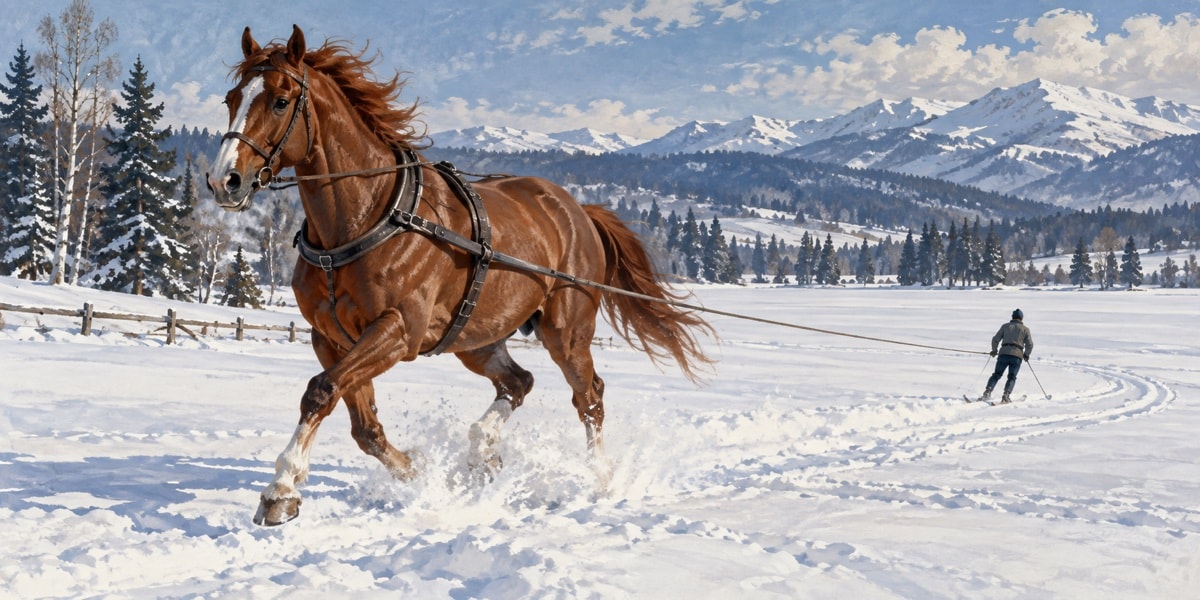
Equestrian skijoring
Skijoring takes its name from a Norwegian word meaning ski driving. In its equestrian form, a skier travels behind a horse, connected by a towline. Some versions emphasize a straight course and speed; others add gates, rings or jumps for the skier. The practice joins horsemanship, harness knowledge, skiing skill and winter conditions in one unusual discipline.
The arrangement changes the normal relationship between horse and rider. The horse may be ridden by one person while towing the skier, or driven under rules suited to a particular event. Either way, the equipment and spacing must allow the horse to move freely without tangling lines or placing the skier where the horse cannot see or avoid them. A calm, conditioned horse and experienced participants matter more than spectacle.
Skijoring also shows how equestrian sports grow from place. Snow, open ground and local winter traditions shaped it; different communities then adapted the idea to recreation and competition. It belongs comfortably beside travel, horse-show management and “A Horse, of Course” because it is not only a technique. It is a small piece of horse culture—part necessity, part play, and part regional identity.
Read by subject
Readers interested in breed traditions can continue to the horse breed reference or the Arabian influence and coat-pattern features. Those thinking about the performance horse can turn to conditioning and recovery. For the horse in history and literature, Canter Magazine remains the natural next stall.
The column subjects offer useful ways to organize a reading question. For a change in schooling, begin with the kind of work involved, then follow the care guide’s discussion of workload, footing and observations afterward. For a barn layout question, think through how horses move between stalls, turnout and the working space before considering how that arrangement fits daily management. Keeping the question specific gives each subject a clear job. A discipline’s history provides context for its movements and equipment; daily observation concerns the particular horse doing the work. Neither can stand in for the other. Returning to the original question after reading both is a useful way to identify what is still uncertain and which details need closer attention in the barn.