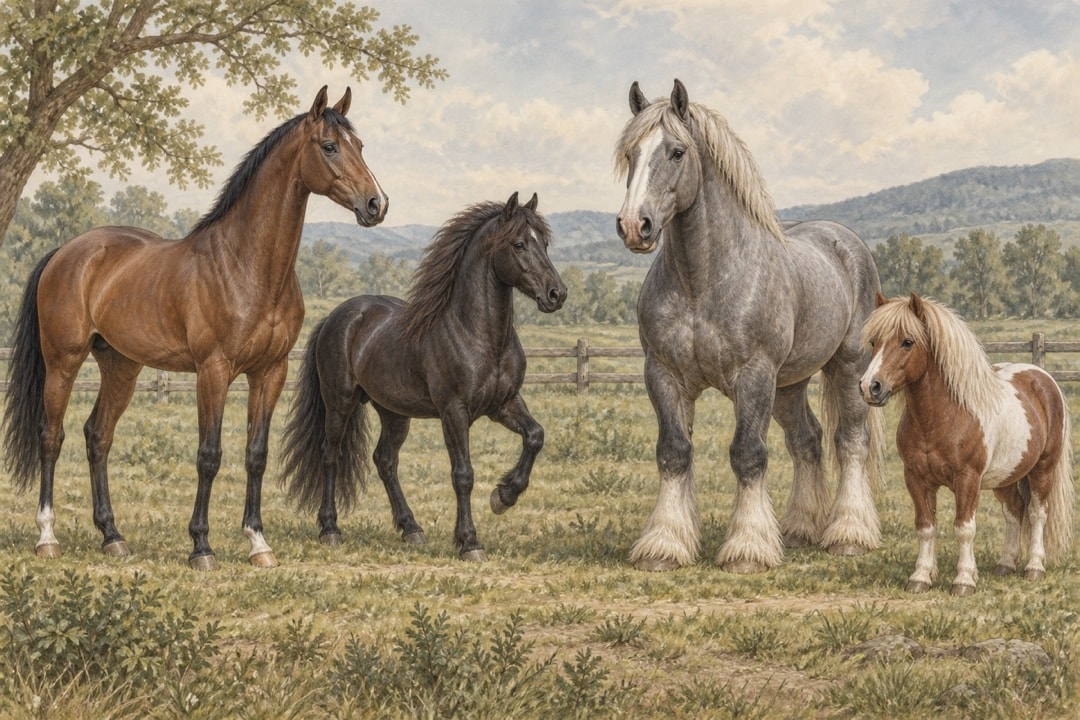
What a breed name tells us
A horse breed is a population shaped over generations toward a recognizable set of traits. Those traits may include body type, movement, color, temperament, place of origin or aptitude for particular work. A breed name is helpful, but it is not a complete prediction of an individual horse. Training, health, conformation, management and experience matter just as much when deciding whether a particular horse suits a particular rider.
A breed registry maintains records under its own published rules. Depending on the tradition, eligibility may rest on documented parentage, inspection, performance, physical characteristics, or some combination of these. “Registered” therefore means that an animal met one organization’s requirements; it is not a universal guarantee of quality, soundness or suitability. Buyers and owners should read the relevant rules directly and evaluate the individual horse in front of them.
Useful types, not rigid boxes
Light horses include many riding and driving breeds developed for speed, agility or endurance. Stock horses emphasize balance, quick acceleration and work around livestock. Gaited horses are bred for intermediate footfall patterns beyond the ordinary walk, trot and canter, often prized for a smooth ride. Warmblood describes several European sport-horse populations developed through selective breeding and inspection, not simply any horse with a certain body temperature or ancestry.
Draft horses were developed for pulling power, while ponies are small equines with proportions and traditions of their own; height alone does not tell the whole story. These groupings overlap. A breed can carry traits from more than one historical purpose, and modern individuals often participate in work far beyond the task for which their ancestors were selected.
Reading a description against the individual
Read the adjectives in a breed description as starting questions. A horse described as willing may still be unfamiliar with a particular task; a horse described as energetic may be settled in familiar surroundings. Ask what the description means in ordinary situations: standing for grooming, leaving companions, waiting at a gate or working in an unfamiliar setting. Those examples make a broad temperament word more useful without turning it into a promise about every member of a breed.
Separate shape from schooling when comparing movement. A long stride and an expressive action describe how a horse moves, while standing quietly for mounting and responding to a rider’s aids involve learned behavior. A breed’s usual work may explain why certain qualities receive attention, but it does not tell you which tasks an individual has practiced.
Comparisons are clearest when the circumstances are similar. Watching a horse in company and then alone answers different questions; so does observing familiar work and a new task. Note the setting beside the behavior, and allow room for a horse’s experience. A description becomes more informative when its general words are connected to something you can actually observe.
Breed notes
Missouri Fox Trotter
Developed in the Ozark region, the Missouri Fox Trotter is associated with a smooth, broken four-beat fox-trot gait and practical travel over uneven country. The tradition favored sure-footed, willing saddle horses able to cover distance comfortably. Oklahoma State University’s breed history offers useful context without substituting for an individual evaluation.
Arabian
The Arabian is an old light-horse tradition recognized for a refined head, arched neck, comparatively short back and efficient endurance. Arabian influence appears in many later riding breeds. Type varies among families and breeding programs, so “Arabian” should begin a conversation about pedigree and purpose rather than end it.
Thoroughbred
Thoroughbreds were developed for speed at the gallop and are strongly associated with racing, yet many have second careers in eventing, hunters, jumpers, dressage and pleasure riding. Their athleticism does not make every individual suitable for every rider; temperament, training history and soundness remain decisive.
American Quarter Horse
The Quarter Horse is a compact, muscular American stock-horse tradition known for rapid acceleration and versatility. Individuals appear in ranch work, western performance, racing, hunter classes and general recreation. Different breeding lines may emphasize substantially different conformation and movement.
Appaloosa
Appaloosas are associated with leopard-complex coat patterns, mottled skin and striped hooves, although expression varies and not every horse displays dramatic spotting. The breed also carries a strong American stock-horse identity. Color is one feature, never a full description of character or ability.
Morgan
The Morgan developed in the United States as a compact, versatile horse for riding, driving and farm work. A Morgan typically presents an alert bearing, substantial body and an ability to turn to many jobs. Modern types range from traditional family and driving horses to specialized show animals.
Andalusian (Pura Raza Española)
The Andalusian, closely associated with Spain’s Pura Raza Española tradition, is known for an elevated presence, strong hindquarters and aptitude for collected work. The familiar gray coat is common but not exclusive. Historical names and modern registry terms are related, yet not always interchangeable.
Friesian
The Friesian comes from the Netherlands and is recognized for its black coat, abundant mane and tail, feathering and expressive action. It has long driving associations and is also seen under saddle. Its striking appearance should not overshadow practical questions about fitness, conformation and intended use.
Tennessee Walking Horse
The Tennessee Walking Horse is a gaited American breed associated with the running walk and a ground-covering saddle gait. Pleasure and trail horses represent an important part of the tradition. Humane training and a naturally performed gait are essential principles whenever gaited horses are evaluated.
Paso Fino
The Paso Fino is a compact gaited horse whose evenly spaced lateral footfalls can create a notably smooth ride. It is rooted in Caribbean and Latin American breeding traditions. The name should not be confused with the Peruvian Paso, which has its own history, characteristic gait and breed identity.
Peruvian Paso
The Peruvian Paso is known for its smooth lateral gait and the distinctive outward motion of the forelegs called termino. It developed as a comfortable traveling horse in Peru. Though often mentioned beside the Paso Fino, it is not simply a regional label for the same breed.
Icelandic horse
The Icelandic horse is a small, sturdy breed with a long history in Iceland. In addition to walk, trot and canter, many individuals perform tölt, and some also pace. Despite pony-like height, the established English name is Icelandic horse, reflecting its cultural and breeding tradition.
Shire
The Shire is a British draft breed selected for pulling power and known for great size, abundant bone and feathering on the lower legs. Its history includes agricultural and road transport work. Modern Shires may be driven, shown, ridden or used in demonstrations of traditional draft work.
Haflinger
The Haflinger originated in the Tyrolean region and is typically chestnut with a light mane and tail. Compact, hardy and versatile, Haflingers are used for riding and driving. Their build can vary from a traditional substantial mountain type to a more refined modern sport type.
Lipizzaner / Lipizzán
The Lipizzaner, or Lipizzán, is a European baroque breed associated with classical riding and careful development over time. Many are born dark and lighten with age, though color alone is not the breed. Their public image is inseparable from highly collected work, but individual training develops gradually.
Przewalski’s horse is not a domestic breed
Przewalski’s horse is a distinct wild equid, not simply a primitive domestic horse breed. It is compact and dun-colored, with an upright dark mane and no forelock. Conservation breeding and reintroduction returned populations to parts of Central Asia after the animal disappeared from the wild. The Smithsonian’s species account explains its biology, habitat and complex relationship to ancient horse populations.
Zorse, zonkey, mule and hinny
A zorse is a zebra–horse hybrid; a zonkey is a zebra–donkey hybrid. These are hybrids, not standardized horse breeds. Zebra striping may appear most strongly on the legs and other parts of the body, but markings and behavior vary. Their novelty should never be mistaken for predictable suitability as riding animals. Zebra ancestry can contribute strong flight responses and handling challenges.
A mule has a male donkey sire and a female horse dam, while a hinny has a male horse sire and a female donkey dam. Mules have a long working history and are valued for endurance and sure-footedness. Most such hybrids are sterile because horse and donkey chromosome sets do not pair normally, though rare exceptions have been recorded. Welfare, experienced handling and a realistic understanding of the individual matter more than a catchy hybrid name.