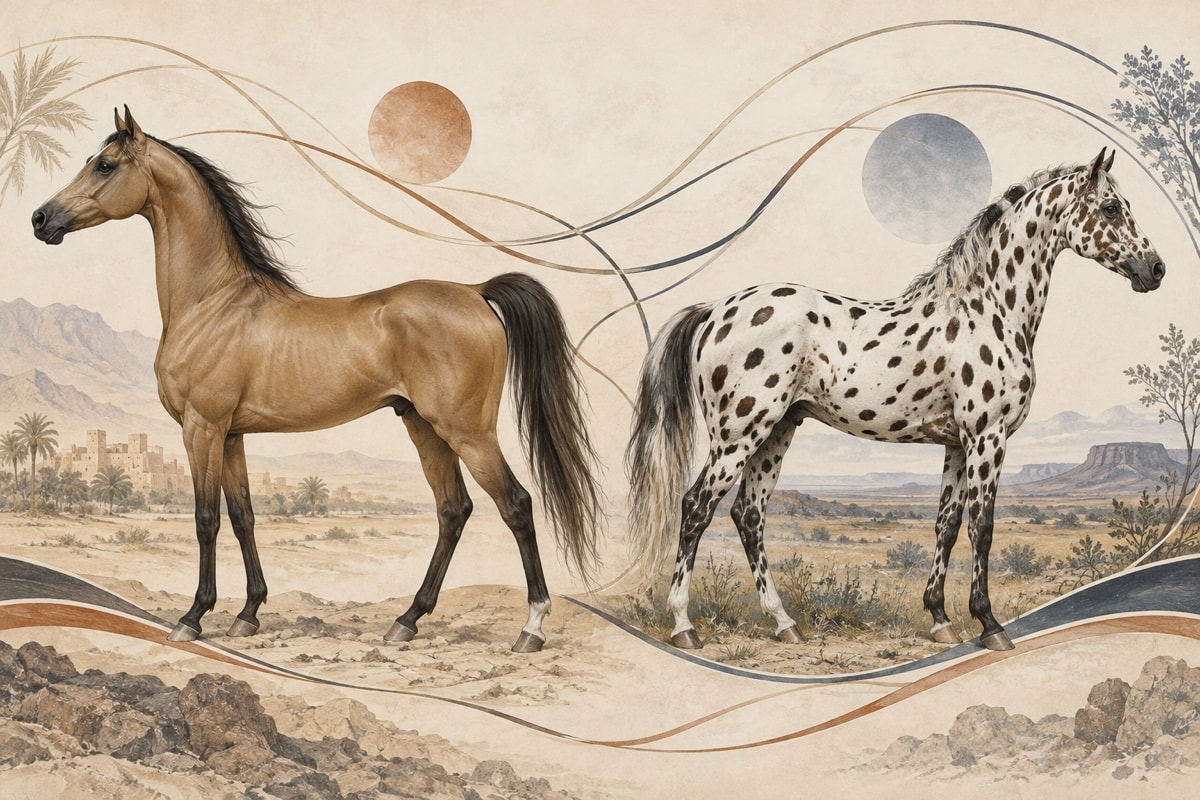
Breed history often arrives as a family story: a celebrated sire, a journey across oceans, a treasured color or a line said to reach back centuries. Those stories matter because they preserve the values of breeders and riders. They also require careful reading. A useful feature separates broad historical influence from a documented pedigree, and a visible coat pattern from the breed identities that may carry it.
The Arabian influence
Arabian horses helped shape many later light-horse populations. Their influence traveled through trade, war, diplomacy and deliberate breeding. European and American breeders used Arabian ancestry when seeking refinement, endurance and a particular kind of athletic light-horse character. Thoroughbreds, several warmblood traditions and a range of regional saddle horses include Arabian influence in different proportions and at different points in their development.
Influence is not the same as identity. A horse does not become Arabian because it has a refined head, high tail carriage or an old story attached to its family. Nor does the presence of Arabian ancestors make every descendant part of the modern Arabian breed. Breed identity depends on the relevant records and rules, while physical type remains variable. Good history therefore uses language such as “contributed to” or “influenced” instead of turning a complex population into a single straight line.
The Arabian itself is not frozen in one show-ring silhouette. Breeding traditions have emphasized endurance, racing, performance, family riding and distinct regional types. Shared ancestry sits beside meaningful variety. That tension—recognizable character without total uniformity—is part of what makes breed history interesting.
The Spanish Arabian
“Spanish Arabian” generally refers to Arabian horses associated with breeding lines developed and maintained in Spain, not a cross between an Arabian and an Andalusian. Spain’s state and private studs played roles in selecting Arabian horses for local goals, and breeders elsewhere later valued those Spanish lines within the wider Arabian population.
As with other strain and bloodline labels, the term deserves precision. It can describe a pedigree tradition, but it should not be used casually to guarantee temperament, conformation or performance. Two horses carrying Spanish Arabian ancestry may look and move differently. The only sound way to make a pedigree claim is through the actual record; appearance alone cannot establish it.
The phrase also sits within a much larger Iberian horse history. The Iberian Peninsula has been a meeting place for horse populations and riding cultures over many centuries. Arabian and North African horses influenced Iberian breeding, while Iberian horses in turn shaped populations in the Americas. Reducing that movement to a tidy one-way origin story loses both evidence and nuance.
Leopard complex: a pattern system, not one spot
Leopard complex describes a family of coat-pattern traits rather than a single design. It is strongly associated with Appaloosas, but related patterns occur in other populations. Expression can include a spotted blanket over the hindquarters, widespread spots, roaning that changes with age, mottled skin, striped hooves and visible white around the eye. Not every trait appears on every horse.
Genetics helps explain why the result is not a simple paint-by-numbers pattern. The major leopard-complex variant affects whether characteristic traits can appear, while other genetic factors influence how much white and spotting is expressed. A horse may carry the underlying variant yet show a subtle pattern; another may be dramatically marked. Color terms used in everyday barns do not always map neatly onto laboratory terminology.
Some horses with two copies of the principal leopard-complex variant are associated with congenital stationary night blindness. That does not mean every spotted horse has a vision problem, and it is not a diagnosis a photograph can make. It does mean that coat genetics can have biological consequences beyond appearance, which is one reason responsible breeders and owners rely on appropriate veterinary and genetic guidance.
Continue the reference
The horse breed guide places the Arabian, Appaloosa and other traditions among broader light, gaited, draft, pony and warmblood groupings. The article library adds the wild story of Przewalski’s horse and the winter discipline of skijoring. Together these features show why horse history is best approached with curiosity—and with room for uncertainty.